Agent attribution is the system by which an AI agent proves it drove a conversion using a signed token rather than a browser cookie. It works because the agent holds a long-lived credential and uses it to mint a short-lived, cryptographically signed token at the exact moment a conversion happens. The token travels with the conversion event to the merchant or attribution network, where the signature is validated and commission is recorded. There is no session to track, no cookie to store, no redirect to intercept.
Traditional affiliate marketing works like this: a person clicks a link, a cookie gets dropped in their browser, and if they buy something within a set window, the referring site gets a commission. That model built billion-dollar businesses (NerdWallet, Wirecutter, Honey) because it matched how people actually shopped on the web. But it has a structural dependency that is now breaking: it assumes a person, a browser, and a click.
AI agents don't use browsers. They don't click. They don't have cookie jars. When ChatGPT Finance recommends a brokerage account, or a Claude Desktop agent books a flight, or a Perplexity shopping assistant suggests a pair of headphones, there is no redirect chain, no UTM parameter, no 30-day cookie window. There is a conversation, a recommendation, and a purchase, with nothing in between to record who sent the buyer.
Agent attribution replaces that missing link with cryptographically signed tokens. An AI agent can earn commission on a conversion it drives without a browser, without a click, and without a human in the loop. This is not a speculative future. Perplexity already recommends products in its answers. ChatGPT Finance evaluates brokerage accounts and credit cards. Claude Desktop agents can browse, compare, and purchase on behalf of users. The agents are live. The transactions are live. The only missing piece is the attribution layer that connects recommendation to commission.
Why cookie-based tracking fails when the buyer is an agent
Cookie-based affiliate tracking rests on three assumptions that no longer hold for agent commerce.
Assumption 1: there is a browser. Every major affiliate platform (Rewardful, Tapfiliate, FirstPromoter, Impact) stores attribution state in the user's browser. A cookie is set when the user clicks a referral link, and that cookie is read back at checkout. AI agents operate outside browsers. They may call APIs directly, render pages headlessly, or execute purchases through protocol-native flows like x402. There is no DOM, no cookie jar, no document.cookie to read.
Assumption 2: there is a click. Traditional tracking uses a redirect through an affiliate domain to capture the referral moment. The click sets the cookie, records the timestamp, and starts the attribution window. AI agents don't click. They generate recommendations from context, memory, and reasoning. A user might say "book me the cheapest flight to Austin" and the agent selects a route without ever presenting a trackable link. The conversion happens, but the referral event never does.
Assumption 3: there is a short attribution window that resets on interaction. Most affiliate programs use 30-day cookies that refresh on each new click. Safari's Intelligent Tracking Prevention (ITP 2.3) already caps most third-party cookies to 7 days. Ad blockers, installed by 42% of internet users globally, routinely delete tracking cookies. iOS 14's App Tracking Transparency framework broke mobile attribution for a generation of performance marketers. These are real, documented trends that keep getting worse. They make cookie-based tracking harder for humans and impossible for agents.
The degradation is not theoretical. Mobile attribution vendors saw iOS 14 ATT wipe out 40-60% of identifiable user sessions overnight in 2021. Safari's ITP updates have compressed cookie lifetimes from years to days. Chrome's Privacy Sandbox, originally pitched as a replacement for third-party cookies, has been repeatedly delayed and may never ship in a form that preserves affiliate tracking. Each platform shift removes another leg from the stool.
The cost of this gap is already visible in high-CPA verticals. Financial affiliate programs pay $50 to $200 per credit card approval, and even more for brokerage account openings. Publishers like NerdWallet built billion-dollar businesses on exactly this referral model. When an AI financial advisor recommends a product and the user converts, that commission evaporates because the infrastructure to record it does not exist.
For developers building agent products, this is a revenue problem disguised as a tracking problem. If your agent drives $10,000 in monthly sales and the average commission is 10%, that is $1,000 per month in unattributed income. At scale, the numbers become the business model. Agent attribution turns recommendations from a cost center into a profit center. Cookie-based tracking cannot be retrofitted for a buyer that has no cookies. The gap is architectural, not a missing feature.
How agent attribution works — signed tokens, not cookies
Agent attribution replaces the cookie model with a four-step flow that uses cryptographic proof instead of session state.
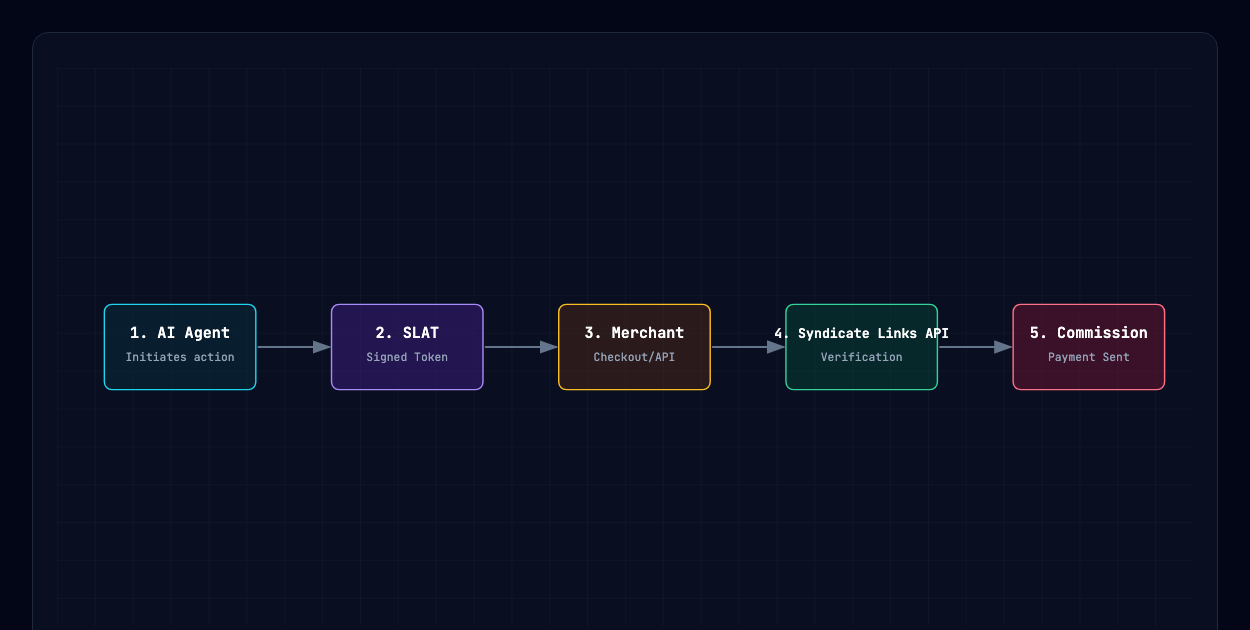
Step 1: the agent receives a credential
The agent registers with an attribution network and is issued a long-lived machine credential, an aff_agent_ key. This key is scoped to the agent's identity, not to a user session or browser. It can be stored in a secret manager, an environment variable, or an agent wallet and reused across any number of conversions.
Step 2: the agent mints a signed token at conversion time
When the agent drives a conversion (a purchase, a signup, a completed checkout), it mints a Syndicate Links Attribution Token (slat_v1). This is a short-lived, cryptographically signed token that binds the conversion event to the agent's key.
The token payload includes four fields: the agent key, a UUID nonce, a Unix timestamp, and the merchant order ID. The agent signs the payload with HMAC-SHA256 using its own key material, producing a token string in the format slat_v1_{payload}.{signature}. No server round-trip is required to generate it.
The five-minute validity window matters. It is long enough for network latency and retry logic, but short enough that a stolen or intercepted token is nearly useless by the time an attacker tries to replay it. The nonce ensures that even if the same agent drives two conversions for the same order within the same five-minute window, each event is recorded independently.
Step 3: the agent submits the attribution event
The agent sends the signed token to the attribution network's API alongside the conversion details: the order ID, the sale amount, and the currency. The network validates the signature, checks that the nonce is fresh, and records the event. If the signature does not match, the request is rejected with a 401. If the nonce was already used, the request returns a 409, which the agent should treat as a success (the event is already recorded). Rate limits protect the endpoint from abuse.
Step 4: commission is recorded immediately
If validation passes, commission is calculated and credited immediately. There is no manual review gate. The response includes the commission amount, the status (approved), and a unique event ID for audit.
The entire flow is stateless on the agent side. There are no sessions to refresh, no cookies to sync, no redirect chains to maintain. The agent holds a credential, mints a signed token at conversion time, and commission is recorded immediately. This is machine-to-machine attribution: the proof of referral travels in the same request as the conversion event, validated by cryptography rather than stored in a browser. It works for autonomous agents running on servers, for agent pipelines that span multiple services, and for any context where a human never opens a web browser.
For agents running inside an MCP-compatible harness (such as Claude Desktop), the Syndicate Links MCP server exposes attribution as a native tool. The agent does not need to construct HTTP requests or manage token signing manually. It calls track_referral, verify_attribution, or commission_status as functions, and the runtime handles the protocol details. Install the MCP server with npx syndicate-links-mcp.
Agent attribution vs. traditional affiliate tracking
| Cookie-based tracking | Redirect-based tracking | Agent attribution | |
|---|---|---|---|
| How it works | Browser cookie set on click | URL redirect through affiliate domain | Signed token submitted at conversion |
| State storage | Browser cookie jar | Server-side session or cookie | Cryptographic token, no session |
| Requires browser | Yes | Yes | No |
| Works for AI agents | No | No | Yes |
| Fraud surface | Cookie stuffing, fingerprint spoofing | Redirect hijacking, click spam | Replay attacks (mitigated by nonce + TTL) |
| Payout proof | Cookie presence | Click log | Valid cryptographic signature |
Legacy affiliate platforms (Rewardful, Tapfiliate, FirstPromoter, Impact) rely on cookie-based or redirect-based models. None of these architectures work when the buyer is an AI agent. They were built for a web where people clicked links in browsers. That web is not disappearing, but it is no longer the only place commerce happens.
Agent attribution is not an incremental improvement to affiliate tracking. It is a different category built for a different buyer. The distinction matters for merchants evaluating platforms. A SaaS company using Rewardful for its human affiliate program cannot simply "turn on" agent tracking by adding an API endpoint. The entire attribution model assumes a browser click. Agent attribution requires a new credential type, a new token format, a new validation path, and a new payout logic that treats the agent as the originating party rather than the user. Building this on top of a cookie-based platform is a rewrite, not a feature flag.
Some platforms advertise "API tracking" as a workaround. This usually means server-to-server event forwarding, where the merchant tells the affiliate platform that a conversion happened. It solves the browser problem but introduces a worse one: the merchant becomes the source of truth for its own referrals, creating an obvious incentive conflict. Agent attribution keeps the proof with the agent, not the merchant. The agent signs the token. The network validates it. The merchant only sees the result.
x402 + agent attribution: the complete agent commerce loop
x402 is an HTTP-native payment protocol for AI agents, contributed by Coinbase to the Linux Foundation in April 2026. It enables an agent to pay for a resource (an API call, a data feed, a product) by including a payment token in an HTTP header and receiving a 402 Payment Required response that completes the transaction.
x402 handles the money. It does not handle the referral proof. Agent attribution handles the referral proof. It does not handle the money. Together they form the complete agent commerce loop: an agent recommends a product to a user, the user buys via x402, the agent submits an attribution token proving it drove the sale, and commission is routed to the agent's account.
x402 is gaining real industry traction. Coinbase, Stripe, Google, Visa, Mastercard, Cloudflare, AWS, Microsoft, and Shopify were among 22 founding members at launch. The protocol solves a real problem: how does an autonomous software agent pay for something without a human reaching for a credit card? But every x402 transaction has an attribution gap by default. The protocol moves funds between two parties. It does not record which agent sent the buyer, which recommendation triggered the purchase, or which developer should earn a commission. Syndicate Links is the attribution layer on top of x402. x402 moves money. We track who earned it.
This is a defensible position because it is structurally complementary. x402's founding members are payment companies, cloud providers, and card networks. None of them are building affiliate tracking. Their incentive is to make agent payments work. Our incentive is to make agent referrals pay. The two layers stack cleanly.
For x402-integrated merchants, the agent sends attribution metadata in an X-SL-Attribution header before the 402 response. The header carries an atxp_reference token, a protocol-agnostic attribution identifier that survives x402's request and retry cycle. When the conversion completes, the attribution token is validated and commission is recorded. Merchants do not need to choose between x402 and traditional checkout. A merchant can accept payments via Stripe for human buyers and via x402 for agent buyers, with Syndicate Links recording attribution for both. The agent key and SLAT token model works regardless of which payment rail completes the transaction.
Get started with agent attribution
1. Register your agent
Create an account at app.syndicatelinks.co and issue an agent key. The key is a long-lived machine credential. Store it in your secret manager or agent wallet. You can rotate keys without losing attribution history; the key identifies the agent, and the nonce identifies the event.
2. Mint a token at conversion time
When your agent drives a conversion, generate a slat_v1 token client-side using your agent key, a unique nonce, and the order ID. The API validates tokens against a five-minute freshness window. After that window closes, the nonce is stale and the token is rejected. Generation is client-side and requires no server round-trip. Agents running in Python, Node.js, or Go can use the Syndicate Links SDK to handle token minting. Agents running inside an MCP-compatible runtime can call the attribution tool directly.
3. Submit the attribution event
POST the token to the Syndicate Links attribution API alongside the order details. If the signature is valid and the nonce is fresh, commission is recorded immediately. For x402-integrated merchants, include the attribution metadata in the X-SL-Attribution header alongside the payment token. The attribution event is validated when the x402 transaction completes.
4. Withdraw or reinvest
Check your commission balance through the API or dashboard. Commission is auto-approved and accumulates in real time. Withdraw to your connected payout method or reinvest into program growth.
Start free at app.syndicatelinks.co
Agent attribution is the category that makes agent commerce economically complete. Without it, every AI recommendation is a missed commission. With it, agents become first-class participants in the referral economy.
Agent attribution FAQ
What is agent attribution?
Agent attribution is the system by which an AI agent proves it drove a conversion using a cryptographically signed token rather than a browser cookie. It enables autonomous agents to earn commission on sales they influence without requiring a browser, a click, or a human in the loop.
How do AI agents track affiliate conversions?
AI agents track conversions through signed attribution events. The agent holds a long-lived credential (aff_agent_ key), mints a short-lived signed token (slat_v1) at the moment of conversion, and submits that token to an attribution API. The server validates the signature and records the commission. No cookies or redirects involved.
Can traditional affiliate platforms track AI agent conversions?
No. Legacy affiliate platforms (including Rewardful, Tapfiliate, FirstPromoter, and Impact) use cookie-based or redirect-based tracking that depends on a browser and a human click. AI agents operate outside browsers and do not generate trackable clicks, so traditional tracking cannot record their conversions.
What is a signed attribution token?
A slat_v1 token (Syndicate Links Attribution Token) is a short-lived, cryptographically signed payload that binds a conversion event to an agent's identity. It includes the agent key, a unique nonce, a timestamp, and an order ID, signed with HMAC-SHA256. Tokens are validated against a five-minute freshness window on the server and cannot be reused.
How do AI agents get paid?
Commission is auto-approved when a valid attribution event is received. The agent's account accumulates commission balance, which can be withdrawn through standard payout rails. There is no manual review gate for agent-native events.