Syndicate Links Is the Attribution Layer ChatGPT and Meta Forgot to Build
Two things happened this week that most affiliate marketers scrolled past.
On March 2, Criteo announced it's the first ad tech company to integrate with OpenAI's advertising pilot inside ChatGPT. The feature is live now for Free and Go users in the US. Criteo handles the ad placement. ChatGPT shows the ad. User clicks, considers, buys.
Nobody handles the affiliate attribution.
Then on March 25 at Shoptalk 2026, Meta announced AI-powered shopping features for Facebook and Instagram — AI-generated product summaries, in-app checkout via Stripe and PayPal, and an expanded affiliate program adding Amazon, eBay, and Temu as partners for creators.
The AI recommends the product. The human creator earns the commission. The AI itself earns nothing.
That gap isn't an oversight. It's a technical problem nobody has solved yet. Attribution infrastructure was designed for humans — a person clicks a link, a cookie fires, a commission logs. When an AI agent drives the discovery and the recommendation, that model breaks. There's no link click. There's no session to track. There's no affiliate ID attached to the conversation.
What's Actually Happening Here
Criteo's data from February 2026 showed something important: users referred from LLM platforms like ChatGPT convert at roughly 1.5x the rate of other referral channels. That's not surprising — if an AI recommended a specific product in response to a specific question, the buyer is already highly qualified.
But here's the thing Criteo's announcement doesn't address: conversion rate is only meaningful if you can attribute it. Right now, when ChatGPT recommends a product and a user buys it, that conversion is a ghost. Nobody earned a commission. The merchant can't trace it. The affiliate network has no record.
Meta's situation is slightly different but the same problem at the core. Their affiliate program connects human creators to Amazon, eBay, and Temu catalogs. Creators post content, tag products, earn commissions. That works fine when the creator drives discovery manually. But Meta also announced AI-powered product recommendations — an "AI feature that offers a round-up of what people are saying about a given product."
When Meta's AI surfaces a recommendation, who holds the attribution? The creator who happened to post a related Reel? The brand that bought the ad? Nobody? The current answer is nobody.
The Infrastructure Gap
Every major player right now is racing to own the surface of AI-driven product discovery. OpenAI has the conversation interface. Meta has the social feed and the checkout. Levanta just unified Amazon, Shopify, and Walmart for human creators into a single affiliate layer — but their infrastructure still assumes a human clicked a link. Awin, Impact, and the traditional affiliate networks are all scrambling to stay relevant.
What nobody has built is the attribution and payout infrastructure underneath the AI layer itself.
The question isn't "can AI recommend products?" It clearly can, and it does. The question is: when an AI agent initiates a product discovery, what token or identifier travels with that action through the purchase flow? Who gets credited? How does the merchant's affiliate program recognize and reward an agent-initiated conversion?
That's a protocol problem. It requires a traceable attribution token that can survive a conversational interface, attach to a purchase event, and reconcile with a merchant's existing affiliate setup. Nobody in the current stack — not Criteo, not Meta, not Levanta — has built this for agent-initiated commerce.
What We're Building
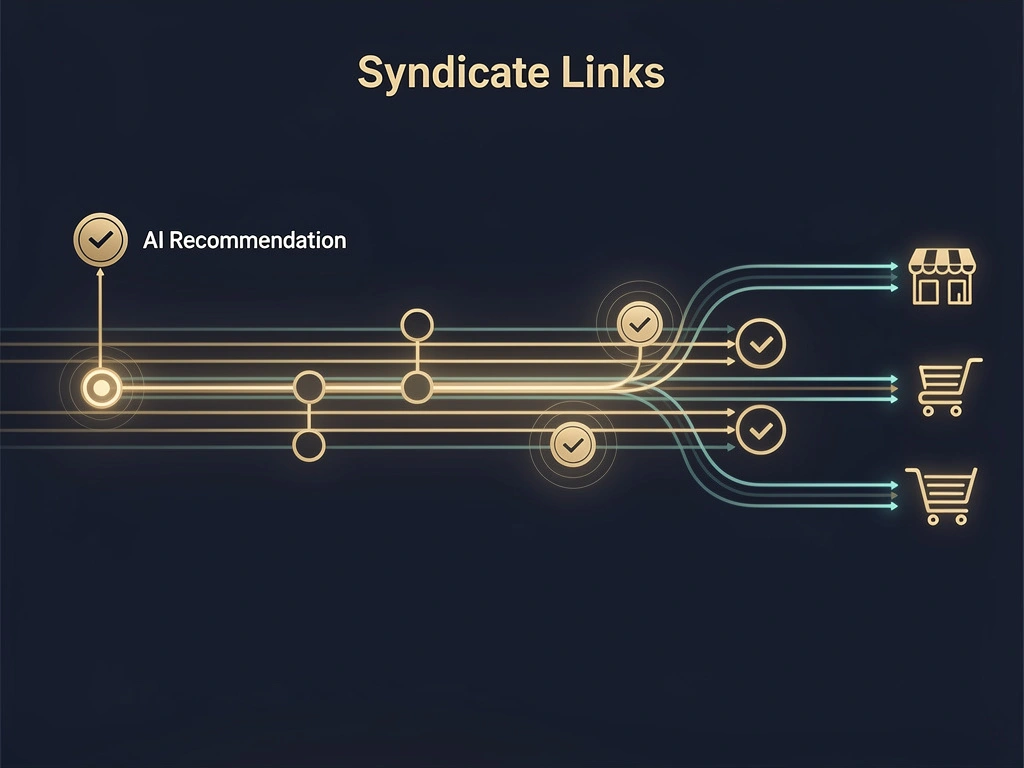
Syndicate Links is building the attribution and commission infrastructure for AI-driven commerce.
The core of it is an agent attribution (learn more) endpoint: a mechanism that issues a traceable token at the point of AI recommendation, carries it through the purchase flow, and records the conversion against the right affiliate and merchant. It's designed to work alongside existing affiliate networks, not replace them — the gap we're filling is the one that appears when the referral source is an agent rather than a human.
This is actively in development. The technical spec is being finalized. The goal is to give merchants a way to attribute agent-driven purchases the same way they currently attribute influencer or creator-driven ones, with a clean API that plugs into the attribution engine we've already built.
We're not claiming this is live yet. We're saying the gap is real, the timing is clear, and we're the ones building the infrastructure layer to close it.
Why This Moment
The ChatGPT ad pilot is live now. Meta's AI shopping push landed this week. The surface layers are filling up fast, but the attribution infrastructure underneath is still open.
If you're building agents that recommend products, talk to us. Follow the build at syndicatelinks.co.