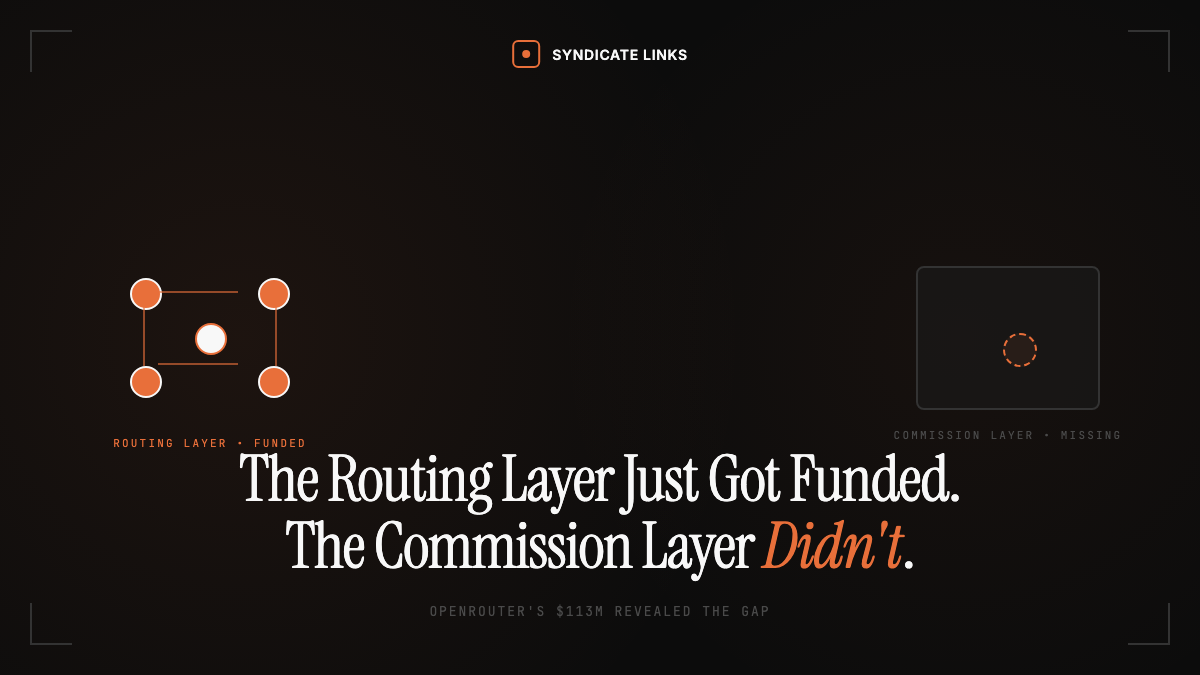
The routing layer just got funded. The commission layer didn't.
Last Wednesday, OpenRouter raised $113 million. The round was led by CapitalG (Alphabet's growth fund) with participation from NVentures (NVIDIA), ServiceNow Ventures, MongoDB Ventures, Snowflake Ventures, and Databricks Ventures.
If you're not familiar with OpenRouter, their product is the layer that sits between an AI agent and the model it calls. You send a query, OpenRouter routes it to the right model (or the cheapest one, or the fastest one that won't fail) across 400+ models. They processed 5 trillion tokens per week six months ago. Now it's 25 trillion.
The Series B announcement describes OpenRouter as "the routing and gateway layer purpose-built for that complexity." A production AI agent needs routing infrastructure to function. OpenRouter is what you use.
Here's the thing that caught my attention about the investor list: Snowflake, Databricks, MongoDB. These aren't AI labs. They're the companies that built the infrastructure every enterprise already depends on for storing, querying, and moving data. They backed a routing layer because routing decisions at scale is infrastructure, and they know what infrastructure at scale actually costs to build correctly.
They're right. And the same logic applies to attribution.
The stack has gaps
The agentic commerce stack, right now, has a few layers that are starting to look funded and real:
You can call any of hundreds of models and swap between them based on cost or performance. OpenRouter is a large part of why that feels easy.
The payment layer is getting there. x402 (now under the Linux Foundation) handles the payment event. Stripe and Cloudflare both shipped native agent commerce APIs in April. The infrastructure for an agent to pay exists.
And the discovery-to-purchase flow is starting to close up.
What's missing is the commission layer. The infrastructure that registers which agent made the recommendation, which publisher built or ran that agent, and what commission that publisher is owed when the transaction completes.
This isn't a niche problem. Every agent-driven transaction that doesn't have attribution baked in is a commission that goes unpaid. The merchant gets a completed sale and no idea who sent it. The publisher gets nothing. The agent gets blamed for every conversion it touches and credited for none.
Why the investor signal matters
OpenRouter's backers aren't making a bet on OpenRouter specifically. They're making a bet on the concept that routing at scale is infrastructure, and infrastructure at scale is a fundable, durable business.
The routing problem OpenRouter solves is this: an agent needs to call a model, and there are hundreds of models, and the right answer changes based on latency, cost, and task type. That information needs to be captured, logged, and acted on in real time. You can't do that with a static config file. You need a routing layer.
The attribution problem is structurally similar. An agent recommends a product. That recommendation crosses through a publisher's MCP server, or a recommendation agent the publisher built, or an affiliate link the publisher set up. The transaction completes. Who sent it? With what signal? What commission applies?
You can't answer those questions with a cookie and a 30-day click window. The agent doesn't have a browser. There's no session to track. The recommendation might have been made three weeks ago and the transaction completed while the user was on a different device running a different agent. Cookie-based affiliate infrastructure wasn't built for this. It fails in the exact same way that a model routing layer built on static config files fails at scale.
The market converged on OpenRouter because routing data-plane decisions at scale requires real infrastructure. The market hasn't converged on anything for attribution yet.
What 25 trillion tokens per week means
The 5x weekly volume growth OpenRouter posted isn't just impressive growth for one company. It's a proxy for how fast agent workloads are scaling in production.
Every token is a potential interaction. A fraction of those interactions end in a commercial recommendation. A fraction of those recommendations result in a transaction. The attribution gap isn't theoretical at 5 trillion tokens per week. At 25 trillion, and growing, the invisible commission problem is already large, just largely untracked.
The infrastructure story for the model routing layer took about two years to become obvious enough to attract CapitalG. The attribution gap has been visible since the first LLM started recommending products, but the data that makes it urgent is still accumulating.
The layer nobody built yet
OpenRouter built the routing layer for model calls. x402 built the payment event layer. Stripe and Cloudflare built the commerce primitives.
The commission routing layer, the infrastructure that connects an agent's recommendation to a publisher's payout, is the piece nobody has shipped at infrastructure scale.
That's what Syndicate Links is building. The same instinct that made data infrastructure companies back a model routing layer applies here: if you're going to process attribution events at the volume that agentic commerce will generate, you need infrastructure that was designed for it, not a cookie retrofitted to survive an environment it wasn't built for.
More at syndicatelinks.co.