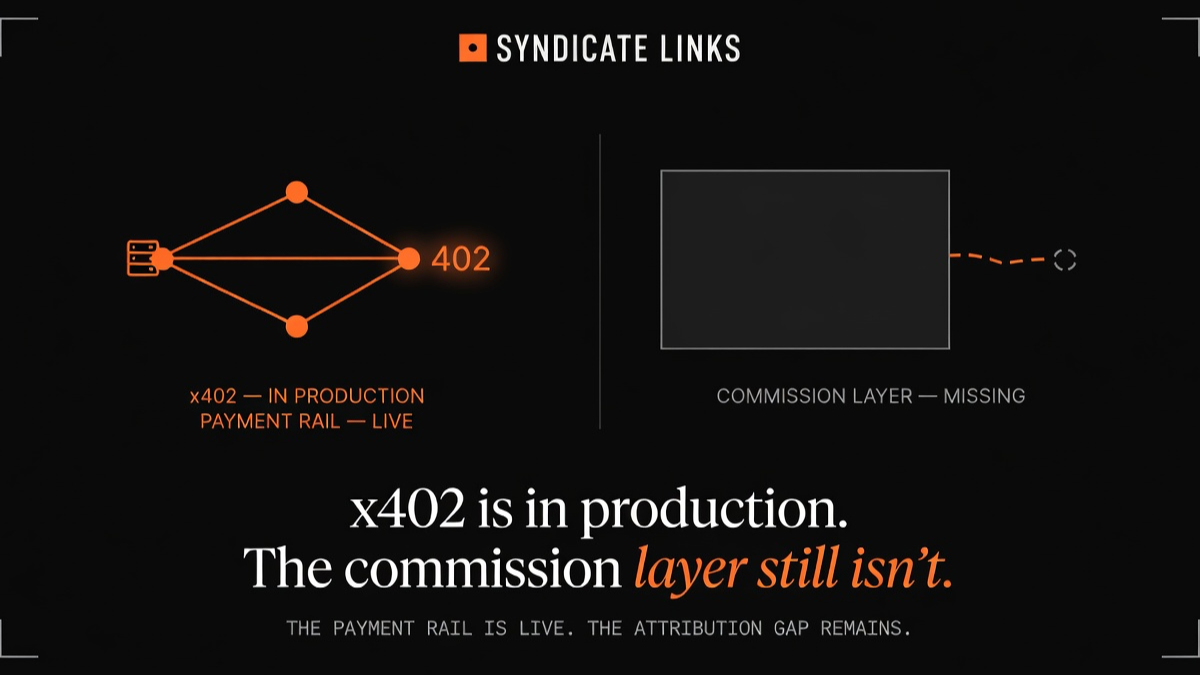
x402 is in production. The commission layer still isn't.
A developer building an agent-powered recommendation tool ships their first x402 integration. One middleware call. No accounts to create, no KYC to clear, no API keys to rotate. When their agent makes a recommendation and a user buys, the payment clears in seconds.
Then they go to figure out how to pay the content creator whose newsletter drove the agent's training data. Or the publisher whose product guides were used to generate the recommendation. That's when the architecture falls apart.
The payment worked. The commission trail doesn't exist.
What changed in the last two months
When x402 launched under the Linux Foundation in April, it was a protocol announcement. The standard existed on paper. Builders could read the whitepaper, browse the GitHub, and understand the architecture. The practical path to deploying it was less clear.
That's different now. In the last 30 days alone, x402 has processed 75 million transactions and $24 million in volume across 22,000 sellers. Stripe is a named partner. The protocol homepage carries their logo alongside AWS, Cloudflare, Vercel, and eight others. The documentation has gone from architectural overview to working quickstart. The homepage pitch is "accept payments with a single line of code," and that's not marketing language. One middleware call, and your server responds with HTTP 402 to any client that doesn't include payment. No account creation or approval steps. Personal information isn't exchanged at all.
Builders across the x402 community have moved past the "should we try this" question. With 75 million transactions and 22,000 sellers, the conversation has shifted from whether x402 works to which implementation patterns hold up at scale.
The payment friction for agent commerce has dropped to near zero. That matters for Syndicate Links because it changes which problem is the hard one.
When friction disappears upstream, it reappears downstream
Here's what happens when payment becomes frictionless: more agent commerce actually gets built. Not as a proof of concept or a demo, but as a real product with real transactions and real revenue. Developers who were waiting for the payment rail to feel solid enough to build on are now building.
And when those products go live, the attribution problem stops being theoretical.
In a world where agent payments are rare and experimental, missing commission attribution is an edge case. Nobody's writing large checks to publishers based on agent-driven sales that barely exist yet. But when x402 makes it possible to deploy a production-grade payment layer in an afternoon, the question of who gets paid and how becomes an immediate operational question.
A publisher whose agent tool drives a thousand product recommendations in a week doesn't want to wait for someone to build attribution infrastructure. They needed it before the payment rail went live.
The commission layer gap is concrete now
The x402 documentation describes what happens when payment works. An AI agent sends a request, receives an HTTP 402 response with payment requirements, pays with stablecoins, gets access. The transaction clears in seconds. No human in the loop. No accounts.
What the documentation doesn't cover is what gets recorded about why the agent was there. Which publisher built the tool that ran the agent? Which content operator trained or prompted it? What commission is owed when the agent's recommendation converts to a purchase?
None of that is in the HTTP 402 response. None of that is in the payment receipt. The transaction is clean and instant and completely opaque about the commercial relationship that made it happen.
The April article framed this as an architectural argument: x402 handles payment, attribution handles commission, these are two separate problems. That framing is right but it was abstract. Now it's concrete. Builders are deploying x402, watching payments clear, and discovering that the commission layer doesn't exist as infrastructure. It's still a custom build, not something you can just plug in.
What attribution infrastructure for x402 needs to look like
The fix isn't complicated conceptually. Before an agent initiates a payment, the publishing context needs to be attached. Which publisher ran this agent, identified by a persistent token that can be verified later. When the payment clears, that publisher token goes into the settlement record. Merchants pull their agent-driven conversion data. Publishers get paid based on verified attribution events, not trust.
This is the same mechanism that makes affiliate marketing work for human-click commerce. But the cookie-and-pixel implementation doesn't survive agent commerce. Agents don't have browsers, don't run JavaScript, don't persist cookies between sessions. Attribution needs to be server-side, signed, and present before the HTTP 402 exchange happens.
Syndicate Links is the infrastructure for that layer. The MCP server handles publisher identity. The x402 token signing handles attribution at the payment event. The attribution API handles settlement. It's designed to sit on top of x402, not replace it.
The payment problem is solved in production. That doesn't weaken the attribution argument. It makes it urgent.
Syndicate Links attribution documentation is at syndicatelinks.co.